You have a solid idea. You want to launch a prediction market platform, maybe something inspired by Polymarket, Kalshi, or Manifold Markets. You have a business model in mind, a target audience, and the drive to get it live.
Then comes the question that stops most founders in their tracks: do you buy a clone script or build it from scratch?
This is not a small decision. It shapes your timeline, your budget, your technical risk, and ultimately how fast you can get users on your platform. The right answer depends entirely on where you are as a business and what you’re trying to achieve.
This guide breaks down both options honestly, so you can make the call with confidence.
What Is a Prediction Market Clone Script?
A prediction market clone script is a pre-built, ready-to-deploy software solution that replicates the core functionality of an existing prediction market platform. Think of it as a fully furnished house: the foundation, plumbing, and wiring are already in place. You come in, repaint the walls, rearrange the furniture, and make it your own.
A quality clone script typically includes:
- Event creation and market management engine
- Real-time trading and order matching
- Smart contract infrastructure (for decentralized platforms)
- Wallet integration and payment gateway support
- Admin dashboard for managing markets, users, and fees
- Automated settlement and payout logic
- Basic KYC/compliance module
When you buy a Polymarket clone, Kalshi clone, or a white label prediction market solution from [Company Name], you are not getting a carbon copy of another business. You are getting a proven technical foundation that you can fully brand, customize, and build upon.
What Is Custom Prediction Market Development?
Custom development means building your platform from the ground up every feature, every smart contract, every API integration designed specifically for your requirements. There is no template, no starting framework. Your development team writes every line of code based on your specifications.
This is the architectural approach chosen by platforms like Polymarket when they launched because they had a unique technical vision, investor backing, and the luxury of time.
Custom development gives you complete control. It also demands significantly more of everything: time, money, technical oversight, and patience.
The Core Comparison: 6 Factors That Actually Matter
Development Timeline
This is usually the deciding factor for most founders.
A prediction market clone script can take your platform from concept to live in 30 to 60 days. The core infrastructure is already built and tested. Your development partner configures it to your specifications, integrates your branding, customizes features, and deploys.
Custom development typically takes 6 to 18 months for a production-ready platform. You are scoping requirements, designing architecture, building and testing every component, auditing smart contracts, and fixing issues that only surface at scale.
If you are trying to capture market momentum and the prediction market space is moving extraordinarily fast in 2026, timeline is not a minor consideration. It is the whole game.
Cost
The cost gap between these two approaches is substantial.
A prediction market clone script including setup, customization, and deployment, typically runs between $10,000 and $50,000, depending on the complexity of your customizations and the provider you work with.
Custom development for a production-ready prediction market platform runs between $100,000 and $400,000 or more. That figure includes frontend and backend development, smart contract development and audit, QA testing, DevOps infrastructure, and the ongoing cost of a technical team to maintain it.
That is not a cost to take lightly, especially for a startup validating product-market fit.
There is also the hidden cost factor to consider: development overruns. Custom builds almost always run longer and more expensive than initially scoped. A 6-month project becomes 9 months. A $150,000 budget becomes $220,000. Clone scripts have a much more predictable cost profile.
Customization & Flexibility
This is where the conversation gets more nuanced.
Modern prediction market clone scripts particularly white label solutions, offer 80 to 90% of the customization capability of a fully custom build. You can modify the UI, add or remove features, choose your blockchain, set your trading rules, configure your fee model, and brand everything to your identity.
What a clone script cannot do as easily is support highly complex or truly novel business logic that deviates significantly from how prediction markets typically work. If you are building something genuinely new, a new type of market mechanism, a proprietary oracle system, a hybrid financial instrument, you may hit the limits of a pre-built framework.
But here is the honest reality: most prediction market platforms do not need that level of novelty, especially at launch. Polymarket succeeded not because it invented a new trading mechanism but because it executed a known model exceptionally well with strong liquidity and a growing user base.
Technical Risk
Every software project carries technical risk. The question is how much of that risk you are taking on.
With a clone scrip, the core architecture has already been tested, audited, and deployed. Smart contracts have been reviewed. The trading engine has been stress-tested. The core security vulnerabilities have been identified and patched in previous iterations. You inherit that stability.
With custom development, every component is new and untested in production. Smart contract vulnerabilities are not always caught in audits, they surface when adversarial users probe the system with real money at stake. A single critical vulnerability in a custom-built smart contract can mean catastrophic loss of user funds and permanent reputational damage.
The DeFi and Web3 ecosystem is full of cautionary stories of platforms that launched too fast with unaudited or improperly tested contracts. A pre-built solution dramatically reduces this category of risk.
Scalability
Both approaches can be built to scale, but getting there looks very different.
A quality clone script is engineered with scalability in mind from the start. Suffescom prediction market solutions are built on modular architecture, meaning you can add features, expand market categories, and handle growing trading volumes without rebuilding the core system.
Custom platforms can also scale, but they require architectural planning from day one. If scalability is not baked into the initial design which often happens when development is rushed, you end up rebuilding major components once you hit user growth.
Ongoing Maintenance & Support
A prediction market platform is not a static product. Markets evolve. Regulations change. New blockchain networks emerge. User expectations shift.
When you build on a clone script from a reputable development company, you get ongoing support, updates, and a team that understands your codebase inside and out. When a critical issue surfaces, you have someone to call.
With a fully custom build, you are dependent on whoever built it. If your development team leaves or you switch vendors, onboarding new developers to a custom codebase is expensive and time-consuming.
Verdict: Clone script wins on long-term maintainability, provided you work with the right partner.
Side-by-Side Summary
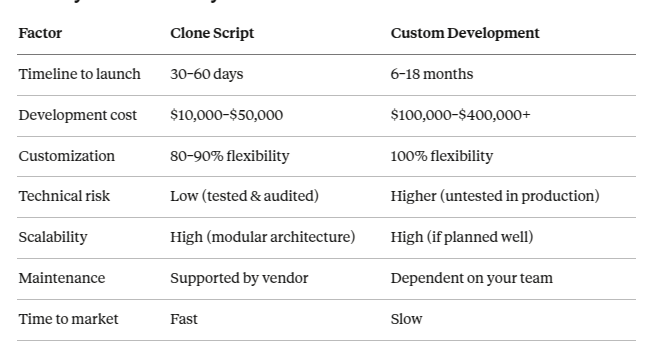
So Who Should Choose Custom Development?
Custom development makes sense in a specific set of scenarios:
You have a genuinely novel mechanism. If you are building something that does not exist, a new type of market structure, a proprietary pricing model, or a regulatory framework that requires custom compliance logic, custom development gives you the architectural freedom to build it right.
You have venture backing and a long runway. Custom development is a realistic option when you have $500,000+ in funding, a 12-month development runway, and access to experienced blockchain developers. For well-funded teams with clear technical requirements and the patience to do it right, custom platforms can be transformative.
You have specific regulatory requirements. Some regulated markets, particularly those targeting the US under CFTC oversight, may require compliance modules that are bespoke to your licensing structure. Custom development allows you to build compliance into the architecture from the ground up.
The Third Option: Clone Script as a Foundation
Here is something most people miss: choosing a clone script does not mean you are locked into a template forever.
The smartest approach for most prediction market businesses is to launch on a clone script, validate with real users, then invest custom development resources into the features that actually matter based on what your market tells you.
You get to market fast, reduce your burn rate during validation, and make smarter custom development decisions with real data. This is how many of the most successful crypto and fintech startups have approached new product categories ship fast, learn fast, build what works.
Suffescom’s white label prediction market platform is designed exactly for this approach: fully deployable as a standalone product, but modular enough that custom features can be layered on top as your platform grows.
What Does Suffescom Offer?
Provides both prediction market clone scripts and fully custom prediction market development, so we can help you make the right choice for your specific situation, not the option that suits our timeline.
Our clone script solutions include:
Polymarket Clone — decentralized, on-chain prediction market with smart contract settlement
Kalshi Clone — regulated, centralized event contract platform with order book trading
Augur Clone Script — fully decentralized, community-governed prediction market
Manifold Markets Clone — social prediction market with community market creation
Hedgehog Markets Clone — Solana-based decentralized prediction platform
White Label Prediction Market Platform — fully brandable, multi-chain ready
All solutions come with audited smart contracts, admin dashboard, wallet integration, and post-launch support.
The Bottom Line
For most prediction market startups, particularly those in the $20,000 to $80,000 budget range who need to validate their idea before going all-in a prediction market clone script is the clear, rational choice. You launch faster, spend less, take on less technical risk, and get to market while the opportunity is still wide open.
Custom development is not wrong. It is just a different tool for a different stage and a different set of requirements.
 Tech Blog
Leave a comment